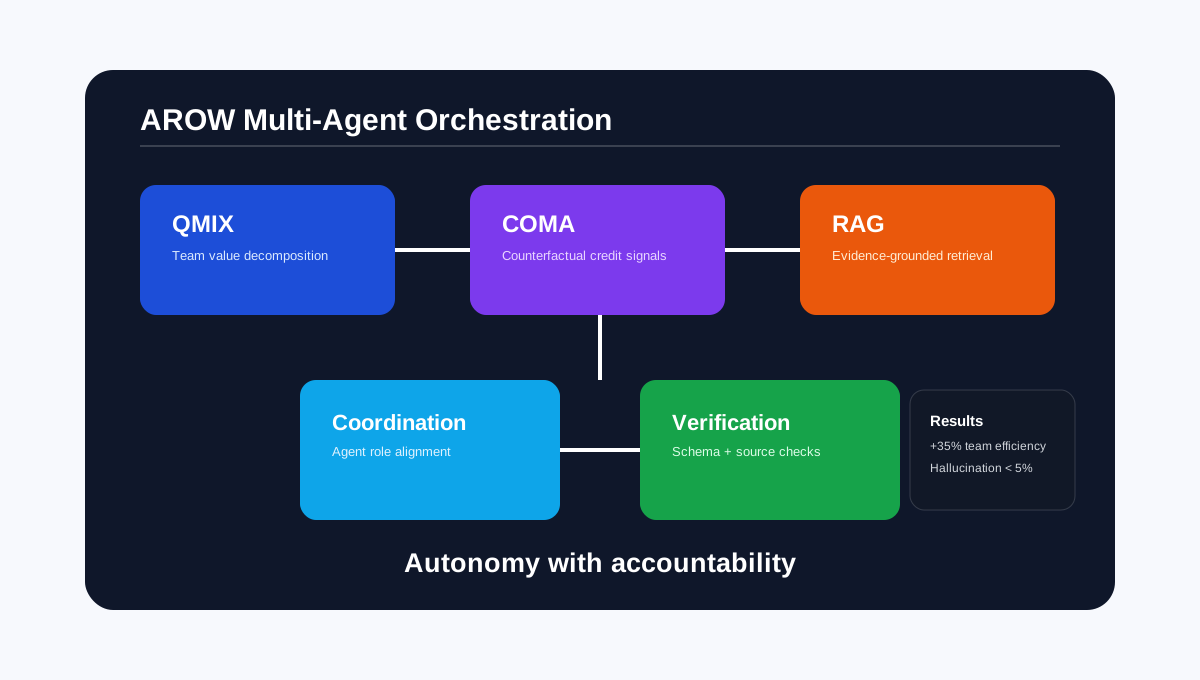
AROW combines multi-agent reinforcement learning and factual grounding to make autonomous AI workflows reliable, accountable, and scalable.
TenseAi Research Desk
Agentic Systems
Mar 10, 2026
12 min read
Most AI agents are strong in isolation but weak in collaboration. AROW solves this by aligning multiple agents around measurable team outcomes while enforcing grounded answers.
The Core Problems in Multi-Agent Work
Credit assignment: knowing which agent improved or harmed the outcome.
Factual reliability: stopping hallucinations in chain-based workflows.
How AROW Works
QMIX models how individual actions impact team success.
COMA teaches each agent to reason about its true contribution.
RAG grounds responses in validated, retrievable evidence.
Independent agents with shared accountability and factual grounding.
AROW also applies schema constraints, source tracking, and reward penalties for unverified outputs. In testing, this reduced hallucination and improved adaptive team behavior in collaborative tasks.
How AROW Handles Dynamic Task Environments
Real-world tasks are not static. Requirements shift, inputs arrive late, and objectives evolve while the system is running. AROW is built for this reality by combining shared reward alignment with role-specific policies. Agents can adapt behavior without losing team-level coordination because optimization remains anchored to global outcome quality.
Planner agents adjust sequencing as new constraints appear.
Retriever agents prioritize updated evidence over stale context.
Validator agents enforce schema and source confidence thresholds.
Coordinator agents rebalance work when one specialist underperforms.
Reliability Layers Beyond Basic RAG
AROW treats factuality as a layered system, not a single retrieval step. Alongside retrieval, it tracks source lineage, checks output schema conformance, and scores contribution quality across agents. If evidence confidence falls below threshold, the system can trigger clarification or defer uncertain claims instead of generating confident but weak outputs.
Retrieve candidate evidence from trusted data planes.
Validate source freshness and relevance for current objective.
Generate candidate response with explicit evidence linkage.
Run schema and consistency checks before final output.
Apply reward updates based on contribution and verification quality.
Where AROW Delivers the Most Value
AROW is most effective in high-stakes, multi-step environments where both speed and trust matter: enterprise research ops, strategic planning, compliance-heavy summarization, and multi-team decision support. In these settings, coordination quality and factual traceability directly impact business outcomes, making AROW's architecture materially better than isolated-agent pipelines.
Lower hallucination exposure in evidence-sensitive workflows.
Better cooperation across specialized agent roles.
Stronger output explainability through traceable sources.
More stable performance under changing objective conditions.